Something feels off. You are sleeping seven or eight hours but waking up completely exhausted. The number on the scale keeps climbing despite no real change to your diet or your routine. You feel irritable one hour and tearful the next, and no clear reason explains either.
For many women in their 30s, 40s, and 50s, these experiences get dismissed. By themselves. By their families. And unfortunately, sometimes by their healthcare providers. They get attributed to stress, aging, being too busy, or simply “that time of life.”
But at Women’s Wellness of SA, one of the most common things we hear from new patients is:
“I thought I was just stressed. I didn’t realize my hormones were the reason I felt this way for years.”
These experiences frequently point to something far more specific: the signs of hormonal imbalance in females, and they go unrecognized and untreated far too often. According to research published through the National Institutes of Health, an estimated 80% of women experience symptoms of hormonal imbalance at some point in their lives, yet a significant number never receive a proper evaluation or a clear explanation for what they are going through.
This blog walks through the 10 most common hormonal imbalance symptoms in females, explains what drives them, outlines the bio-identical HRT therapies available at our clinic, and helps you understand whether
Hormone Replacement Therapy (HRT) could be the answer your body has been waiting for. If you are in San Antonio, Universal City, Schertz, or the surrounding area, our team of female hormone specialists is here to help.
What Is Hormonal Imbalance?
Hormonal imbalance occurs when the body produces too much or too little of one or more key hormones. In women, the hormones most frequently involved include estrogen, progesterone, testosterone, cortisol, thyroid hormones, and human growth hormone (HGH). These chemical messengers regulate nearly every system in the body, from mood and metabolism to sleep cycles, bone density, libido, and reproductive health.
Think of your hormones as a finely tuned network. When even one falls significantly out of range, the effects ripple across multiple systems at once. That is why the symptoms of hormonal imbalance in women rarely appear one at a time; they cluster, which makes the hormonal connection easy to overlook or misattribute to something else entirely.
Importantly, hormonal imbalance in women is not limited to menopause. Perimenopause, the transitional phase before a woman’s final period, can begin as early as the mid-30s and last up to a decade, during which estrogen and progesterone levels fluctuate unpredictably before beginning their long-term decline. Hormones can also be disrupted at any age by chronic stress, thyroid dysfunction, nutritional deficiencies, surgical menopause, or other underlying conditions.
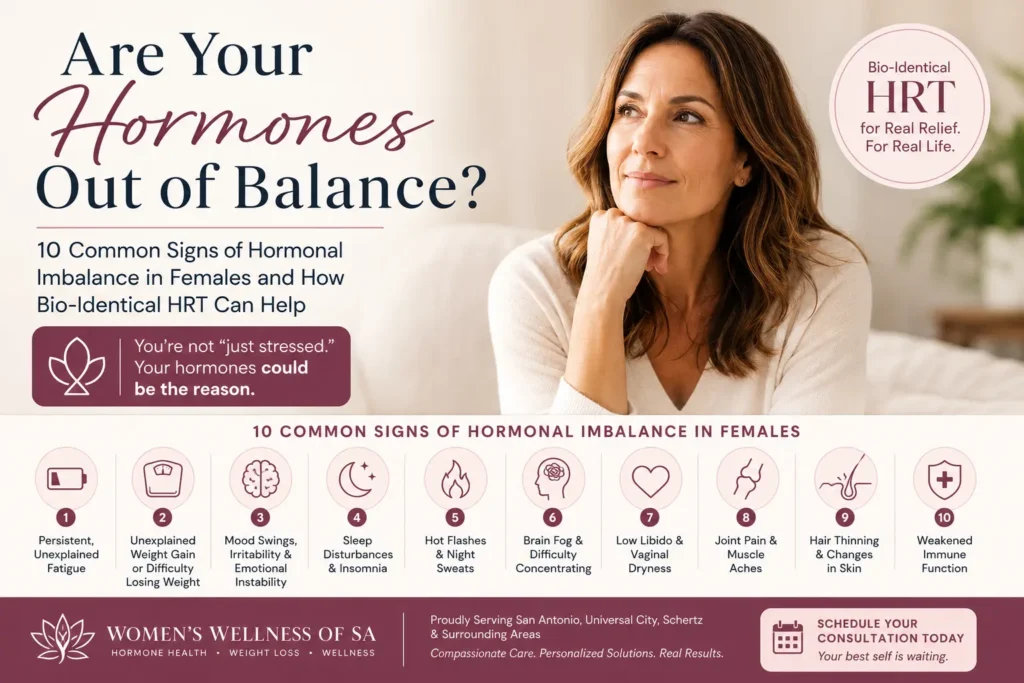
10 Signs of Hormonal Imbalance in Females
The symptoms below are the most commonly reported hormonal imbalance symptoms in females seen by our clinical team at Women’s Wellness of SA. If you recognize four or more of these on a regular basis, a hormonal evaluation is strongly recommended.
1. Persistent, Unexplained Fatigue
You are sleeping enough hours, but you wake up exhausted and stay that way throughout the day. This is one of the most universal symptoms of hormonal imbalance, often caused by declining estrogen, low progesterone, low cortisol, or dysregulated thyroid function. Caffeine does not fix it because the root cause is not poor sleep; it is hormonal dysregulation.
2. Unexplained Weight Gain or Difficulty Losing Weight
Estrogen plays a direct role in regulating fat distribution and metabolic rate in women. As estrogen declines during perimenopause and menopause, fat tends to redistribute toward the abdomen even when caloric intake and activity levels remain unchanged. If your weight has been increasing without a clear reason, hormonal imbalance, not willpower, is frequently the cause. Our
Medical Weight Loss program addresses this through a hormone-informed approach.
3. Mood Swings, Irritability, and Emotional Instability
Estrogen and progesterone directly influence the brain’s production of serotonin and GABA, the neurotransmitters most responsible for mood regulation and emotional calm. When these hormones decline or fluctuate unpredictably, mood becomes unstable. Women describe feeling like they are “not themselves”, snapping at people they love, crying without knowing why, or swinging between fine and overwhelmed within the same hour.
4. Sleep Disturbances and Insomnia
Progesterone has a natural sedative effect and supports the body’s ability to fall and stay asleep. When progesterone declines, sleep becomes lighter, more fragmented, and less restorative. Night sweats, driven by estrogen fluctuation, compound the problem by waking women multiple times throughout the night, creating a cycle of chronic sleep deprivation.
5. Hot Flashes and Night Sweats
Hot flashes are the most recognized sign of hormonal imbalance related to menopause and perimenopause. They are caused by estrogen decline disrupting the hypothalamus, the brain’s temperature regulation center, which triggers sudden waves of intense heat, flushing, and sweating. According to the North American Menopause Society (NAMS), up to 75% of women experience hot flashes during the menopausal transition.
6. Brain Fog and Difficulty Concentrating
Estrogen supports cognitive function, memory consolidation, and mental sharpness. When estrogen declines, many women experience noticeable cognitive changes, difficulty focusing, forgetting words mid-sentence, feeling mentally “cloudy” or slow. This symptom is frequently dismissed as stress or aging, but it has a clear hormonal mechanism and often improves significantly with appropriate HRT.
7. Low Libido and Vaginal Dryness
Testosterone in women (yes, women produce testosterone too, though in smaller amounts) is a primary driver of sexual desire, arousal, and energy. Estrogen maintains the health and moisture of vaginal tissue. When either or both decline, the results include reduced or absent sex drive, vaginal dryness, and discomfort during intercourse. These symptoms are common, deeply impactful on quality of life and relationships, and highly treatable.
8. Hair Thinning and Skin Changes
Estrogen supports healthy hair growth cycles and skin collagen production. When estrogen declines, hair follicles produce thinner strands and shed more readily. Skin loses elasticity, becomes drier, and may develop new sensitivity. Testosterone imbalance can also contribute to hair thinning, or conversely, to unwanted facial hair growth, depending on how hormones are shifting relative to one another.
9. Irregular, Heavy, or Absent Periods
During perimenopause, the menstrual cycle often becomes irregular, periods may be heavier, lighter, longer, shorter, or skip entirely as ovulation becomes inconsistent. While some irregularity is expected, significant changes to your cycle are your body’s signal that hormonal shifts are underway and worth evaluating.
10. Anxiety, Depression, and Loss of Motivation
Beyond mood swings, some women experience a more sustained shift toward anxiety or depression as estrogen and progesterone decline. These are not simply emotional responses; they are physiological. The hormonal changes directly alter brain chemistry. Women who have no prior history of anxiety or depression are frequently surprised to develop these symptoms in their 40s and 50s. The connection to hormones is well-established and documented by the American College of Obstetricians and Gynecologists (ACOG).
Perimenopause vs. Menopause: Understanding Where You Are
Many women are unclear about the difference between perimenopause and menopause, and why it matters for treatment. This table clarifies the key distinctions:
|
Perimenopause |
Menopause |
Post-Menopause |
| Definition |
Transition phase before menopause |
12 consecutive months without a period |
All years after menopause |
| Typical Age Range |
Mid-30s to early 50s |
Average age 51 (range: 45–55) |
51+ |
| Hormone Pattern |
Fluctuating estrogen and progesterone |
Sustained estrogen and progesterone decline |
Continued low hormone levels |
| Periods |
Irregular — may be heavier or lighter |
Absent for 12+ months |
None |
| Most Common Symptoms |
Mood swings, irregular periods, fatigue |
Hot flashes, night sweats, vaginal dryness |
Bone loss, cardiovascular risk, brain fog |
| HRT Eligibility |
Often highly effective |
Core treatment window |
May still be appropriate — requires evaluation |
From Our Clinic: At Women’s Wellness of SA, we find that many women arrive thinking they are “too young” for hormonal treatment, but perimenopause can begin a full decade before the final menstrual period. If your symptoms are affecting your daily life, your relationships, or your sleep, you are not too young to seek an evaluation.
How Is Hormonal Imbalance Diagnosed?
Diagnosing hormonal imbalance requires more than recognizing symptoms, it requires measuring what is actually happening in your body. At Women’s Wellness of SA, our female hormone specialists conduct a comprehensive evaluation that includes:
- Comprehensive blood panel — measuring estrogen (estradiol), progesterone, testosterone (total and free), thyroid hormones (TSH, T3, T4), cortisol, DHEA, insulin, and FSH (follicle-stimulating hormone)
- Detailed symptom review — a structured conversation about when symptoms began, how frequently they occur, and how significantly they are affecting your daily life, sleep, work, and relationships
- Complete medical history review — including prior diagnoses, family history, current medications, and any previous hormonal treatment
- Physical examination — to assess overall health status and identify any contraindications to hormonal therapy
A
Women’s Wellness Exam at our clinic is an excellent starting point for this evaluation if you have not had a comprehensive checkup recently.
Bio-Identical HRT Options Available at Women’s Wellness of SA
Once your evaluation is complete, our female hormone specialists design a personalized treatment plan based on your specific hormone levels, symptoms, medical history, and health goals. Women’s Wellness of SA offers four types of bio-identical Hormone Replacement Therapy — each targeting a specific hormonal need:
1. Estrogen Therapy
The cornerstone of menopausal hormone treatment. Estrogen therapy addresses hot flashes, night sweats, vaginal dryness, brain fog, skin changes, and sleep disturbances by restoring estrogen to an appropriate level for your body. Bio-identical estrogen is structurally identical to the estrogen your body produces naturally, which distinguishes it from synthetic alternatives.
2. Progesterone Therapy
Progesterone is paired with estrogen therapy in women who have a uterus to protect the uterine lining. Beyond this protective role, progesterone has its own benefits; it supports sleep quality, reduces anxiety, and contributes to mood stability. Women with progesterone deficiency often report significant improvement in sleep and emotional symptoms with progesterone therapy alone.
3. Testosterone Therapy
Often overlooked in women’s hormonal care, testosterone plays a critical role in female sexual health, energy levels, motivation, mental sharpness, and body composition.
Women’s Wellness of SA offers testosterone therapy for women experiencing low libido, persistent fatigue, loss of motivation, and reduced muscle tone, all of which may indicate testosterone deficiency alongside estrogen and progesterone changes.
4. Human Growth Hormone (HGH) Therapy
Human Growth Hormone naturally declines with age in both men and women. In women, HGH deficiency can contribute to increased body fat (particularly abdominal fat), reduced muscle mass, lower energy, poorer sleep quality, and accelerated skin aging. HGH therapy, when clinically indicated and carefully monitored, can help restore body composition, energy, and overall vitality as part of a comprehensive hormonal wellness plan.
The Benefits of Bio-Identical Hormone Replacement Therapy
When appropriately prescribed and monitored, bio-identical HRT offers documented benefits that extend well beyond symptom relief:
- Relief from menopausal symptoms — hot flashes, night sweats, and vaginal dryness resolve or significantly reduce in most treated patients
- Improved sleep quality — progesterone normalization restores deeper, more restorative sleep
- Enhanced mental clarity and focus — estrogen restoration frequently reverses brain fog and improves memory
- Stabilized mood and reduced anxiety — hormonal balance restores the neurochemical environment for emotional stability
- Bone density preservation — estrogen is critical to maintaining bone density; HRT is one of the most effective preventive strategies against osteoporosis
- Cardiovascular protection — when initiated within 10 years of menopause, estrogen therapy is associated with reduced cardiovascular risk in healthy women, according to NAMS
- Improved sexual health — testosterone and estrogen restoration improve libido, arousal, and comfort during intercourse
- Better weight management — addressing the hormonal drivers of metabolic slowdown supports healthier body composition alongside lifestyle changes
- Overall quality of life — the cumulative effect of the above is a return to the energy, clarity, and vitality that hormonal decline had diminished
Is HRT Right for You? Candidacy and Contraindications
Hormone Replacement Therapy is not a one-size-fits-all treatment. Determining whether it is right for you requires a professional evaluation of your full health profile. Our specialists at Women’s Wellness of SA will review all of the following before recommending any hormonal treatment.
HRT may be highly beneficial if you:
- Experience moderate to severe symptoms affecting daily life, sleep, or work
- Are in perimenopause or menopause and have not found relief through lifestyle changes alone
- Experienced early or surgical menopause before age 40–45
- Have a family history of osteoporosis and want proactive bone protection
- Experience symptoms of testosterone or HGH deficiency alongside estrogen decline
- Are seeking a bio-identical, personalized approach to hormonal care
HRT is generally not recommended if you have:
- A personal history of breast, ovarian, or uterine cancer
- A history of blood clots, stroke, or deep vein thrombosis (DVT)
- Active or chronic liver disease
- Unexplained vaginal bleeding that has not been evaluated
- Certain cardiovascular conditions (evaluated case-by-case)
Every contraindication is evaluated individually. A history of one of the above conditions does not automatically rule out hormonal treatment, but it does require a more detailed review and careful risk assessment.
At Women’s Wellness of SA, our goal is never to place every patient on HRT. Our goal is to determine why you are experiencing symptoms and identify the safest, most effective treatment approach for your specific situation. For some women, that includes bio-identical
hormone replacement therapy. For others, lifestyle changes, nutritional support, medical weight loss strategies, or ongoing monitoring may be more appropriate.
The right treatment is the one that addresses the root cause of your symptoms while supporting your long-term health.
What to Expect During Your Hormone Evaluation
Many women delay seeking help because they are unsure what a hormone consultation actually involves. The process is often much simpler and more informative than patients expect.
Step 1: Comprehensive Symptom Review
Your provider will discuss:
- Current symptoms
- Sleep quality
- Energy levels
- Mood changes
- Weight fluctuations
- Menstrual history
- Sexual health concerns
- Previous hormone treatments
- Family medical history
Step 2: Laboratory Testing
Advanced blood testing may include evaluation of:
- Estradiol
- Progesterone
- Testosterone
- Thyroid hormones
- Cortisol
- DHEA
- Insulin
- Follicle-Stimulating Hormone (FSH)
- Additional markers based on symptoms
Step 3: Women’s Wellness Examination
A comprehensive wellness evaluation helps identify other health concerns that may be contributing to symptoms, including thyroid disorders, metabolic changes, cardiovascular risk factors, and nutritional deficiencies.
Step 4: Personalized Treatment Plan
Once results are available, your provider develops a customized treatment strategy based on:
- Hormone levels
- Symptom severity
- Age and life stage
- Personal health goals
- Medical history
- Risk profile
No two women receive the exact same treatment plan because no two hormonal profiles are identical.
Why Early Treatment Matters
One of the biggest misconceptions about hormonal imbalance is that symptoms are simply something women must tolerate.
They are not.
Hormonal symptoms often worsen gradually over time. What begins as mild fatigue may progress into chronic exhaustion. Occasional night sweats may become nightly sleep disruption. Small amounts of weight gain may evolve into significant metabolic changes.
Beyond symptom relief, appropriate hormonal treatment may help support:
- Bone density preservation
- Cardiovascular health
- Cognitive function
- Sexual wellness
- Sleep quality
- Long-term quality of life
According to the North American Menopause Society, women who begin appropriate hormone therapy within the recommended treatment window often experience substantial improvements in both symptom control and overall well-being.
Clinical Note From Our Specialists
At Women’s Wellness of SA, many patients tell us they spent years searching for answers before discovering hormones were contributing to their symptoms.
Some were told their symptoms were simply stress.
Others believed they were too young for perimenopause.
Many assumed weight gain, fatigue, anxiety, brain fog, and sleep disruption were unavoidable parts of aging.
In reality, these symptoms frequently have identifiable hormonal causes that can be evaluated and treated.
You do not have to wait until symptoms become severe before seeking help.
Why Women Choose Women’s Wellness of SA
As part of Hillside Medical Group, Women’s Wellness of SA provides comprehensive care focused specifically on women’s health and hormonal wellness.
Patients choose our practice because we offer:
- Female hormone specialists
- Personalized bio-identical hormone therapy
- Estrogen therapy
- Progesterone therapy
- Testosterone therapy
- Human Growth Hormone (HGH) therapy
- Women’s wellness exams
- Medical weight loss programs
- Comprehensive laboratory testing
- Individualized treatment plans
- Convenient locations serving San Antonio, Universal City, Schertz, Live Oak, and surrounding communities
Our mission is simple: help women feel like themselves again.
Schedule Your Hormone Evaluation
If you are experiencing symptoms of hormonal imbalance, the first step is getting answers.
Whether you are struggling with fatigue, weight gain, hot flashes, mood swings, brain fog, low libido, sleep disruption, or other unexplained symptoms, a professional hormone evaluation can help identify the underlying cause and determine the best treatment path forward.
Women’s Wellness of SA provides comprehensive hormone evaluations and personalized bio-identical hormone replacement therapy for women throughout the San Antonio area.
Call: 210-858-9767
Book Online:
Women’s Wellness of SA Appointment Page
Hours: Monday-Friday, 8:00 AM-5:00 PM
Locations Served: San Antonio, Universal City, Schertz, Live Oak, and surrounding communities
Don’t spend another year wondering why you don’t feel like yourself.
The answers may be hormonal. And effective treatment may be closer than you think.
Frequently Asked Questions About Hormonal Imbalance and HRT
1. What are the most common signs of hormonal imbalance in females?
The most common symptoms include fatigue, weight gain, mood swings, anxiety, hot flashes, night sweats, low libido, sleep problems, brain fog, irregular periods, hair thinning, and vaginal dryness.
2. At what age does hormonal imbalance typically begin?
Hormonal changes can occur at any age, but many women begin experiencing symptoms during perimenopause, which may start in the mid-30s to early 40s and continue into menopause.
3. How do I know if I need hormone replacement therapy?
If hormonal symptoms are affecting your quality of life, sleep, relationships, work performance, or overall well-being, a professional evaluation can determine whether HRT is appropriate.
4. Is bio-identical hormone therapy safe?
For appropriately selected patients under medical supervision, bio-identical hormone therapy is considered a safe and effective treatment option. Your provider will review your personal medical history and risk factors before making recommendations.
5. Does HRT cause weight gain?
Contrary to popular belief, HRT is not typically responsible for weight gain. In many cases, hormonal imbalance itself contributes to metabolic changes and abdominal weight gain. Appropriate hormone treatment may actually support healthier body composition when combined with proper nutrition and exercise.
6. How quickly does HRT start working?
Some women notice improvements in sleep, energy, and mood within a few weeks. More significant symptom improvement often occurs over several months as hormone levels stabilize.
7. Can hormonal imbalance cause anxiety and depression?
Yes. Estrogen and progesterone influence several neurotransmitters involved in mood regulation, including serotonin and GABA. Hormonal fluctuations can contribute to anxiety, depression, irritability, and emotional instability.
8. What hormones are tested during a hormone evaluation?
Testing often includes estrogen, progesterone, testosterone, thyroid hormones, cortisol, insulin, DHEA, and FSH, depending on symptoms and medical history.
9. Is HRT only for menopause?
No. Hormone therapy may also benefit women experiencing symptoms during perimenopause, early menopause, surgical menopause, or documented hormone deficiencies unrelated to menopause.
10. Can hormonal imbalance affect bone and heart health?
Yes. Declining estrogen levels are associated with reduced bone density and increased cardiovascular risk. Appropriate hormone therapy may help support both bone and heart health in eligible patients.
Medical Disclaimer
This article is intended for educational purposes only and should not be considered medical advice. Hormonal symptoms can have multiple causes, and every patient requires individualized evaluation and treatment recommendations from a qualified healthcare professional. Always consult your healthcare provider regarding medical concerns, diagnosis, or treatment decisions.